The Architecture of Atmosphere: Lighting Design for Arenas and Stadiums
The Unseen Architecture of Modern Spectacle
An arena tour is more than a concert; it’s a temporary city, a vibrant, ephemeral metropolis of light, sound, and shared emotion. For the thousands who pour into the stands, the experience is a total sensory immersion. But this spectacle doesn’t simply happen. It’s meticulously designed, with light as its primary architectural element. For the modern tour manager, brand marketer, or live-experience designer, understanding the principles of stadium and arena lighting is to understand the very mechanics of atmosphere, connection, and memory.
At its core, large-scale lighting design is a study in scalability and intimacy. How do you make a space built for 50,000 feel personal? How do you direct the focus of a crowd the size of a small town? The answer lies in a layered approach, one that treats the entire venue—from the front row to the highest tier, and even the air itself—as a single, dynamic canvas.
Principle 1: The Audience as the Canvas
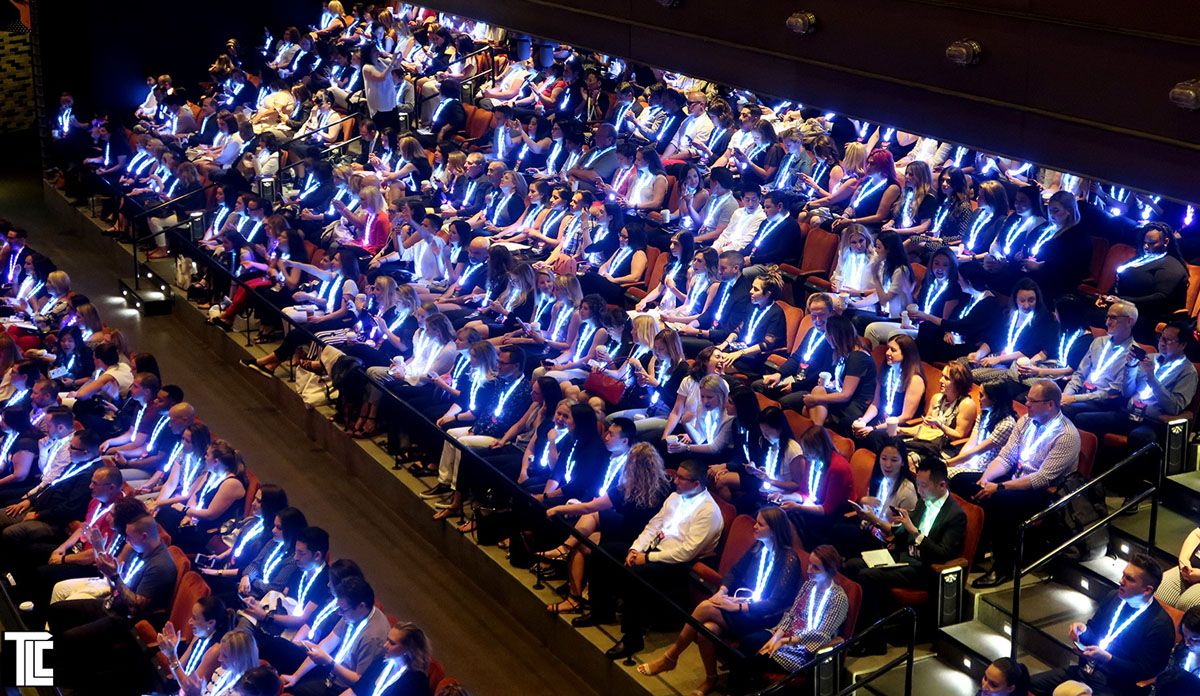
The most profound shift in live event production over the past decade has been the integration of the audience directly into the visual design. The passive spectator is a relic. Today, the crowd is the show. This is the foundational principle behind Xylobands and the rise of wearable LED technology.
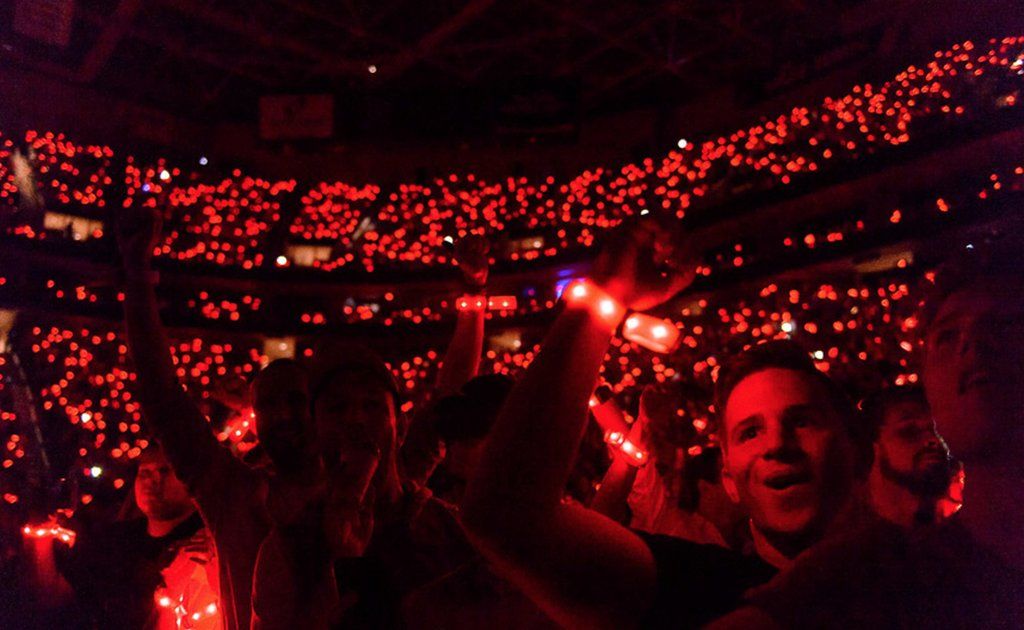
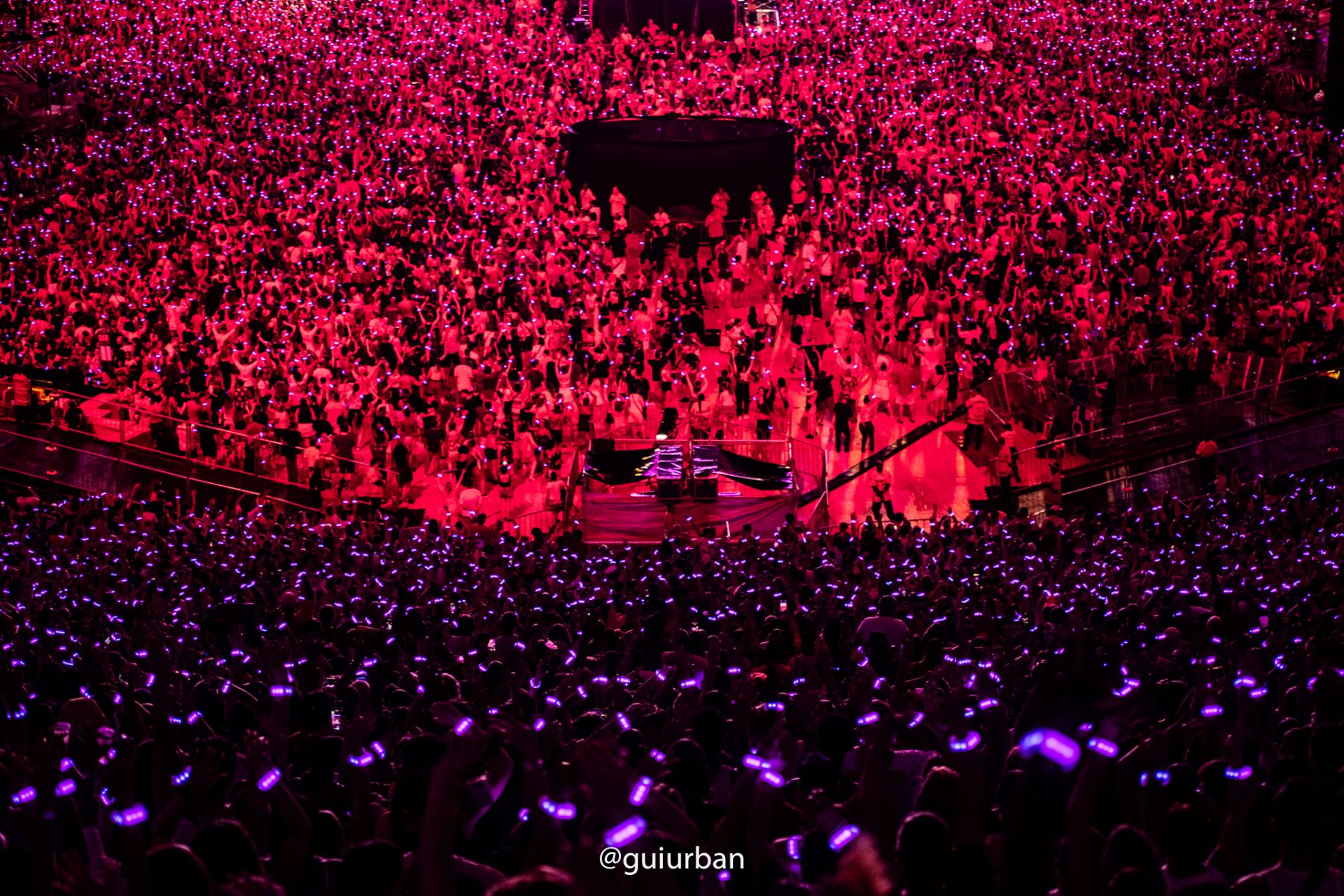
By transforming each audience member into a pixel, a single point of light in a much larger picture, designers can create breathtaking visual moments that are both vast and deeply personal. When 54,000 fans at Maluma’s historic Medellín concert lit up in unison, the stadium wasn’t just a venue; it became a living, breathing entity, its collective energy visualized in real-time. This is the power of LED crowd experiences—they dissolve the barrier between the performer and the fan, fostering a powerful sense of unity.
This approach isn’t limited to music. At the Davis Cup, often called the “World Cup of Tennis,” the challenge was to channel the passionate, nationalistic fervor of the crowd into a cohesive and visually stunning experience. By deploying radio controlled LED wristbands, the entire arena could be washed in a team’s colors after a critical point, amplifying the roar of the crowd and turning moments of high drama into powerful visual statements. It’s an evolution in live sports, where the emotional energy of the fans becomes a tangible part of the game’s narrative.
Principle 2: Designing for Depth and Dimension
In a stadium, the sheer scale of the space can be a challenge. Without careful design, the environment can feel cavernous, the stage distant. Effective lighting design conquers this by creating layers of light, adding depth, and defining the architectural volume of the space.
- Key Lighting: This is the traditional workhorse, focused on illuminating the performers. But in an arena, it must be powerful and precise, cutting through atmospheric haze and competing with massive video screens.
- Fill and Ambient Lighting: This layer softens the shadows and makes the environment feel less harsh. It’s often used to paint the architecture of the venue itself—the trusses, the roof, the seating bowls—in color and texture.
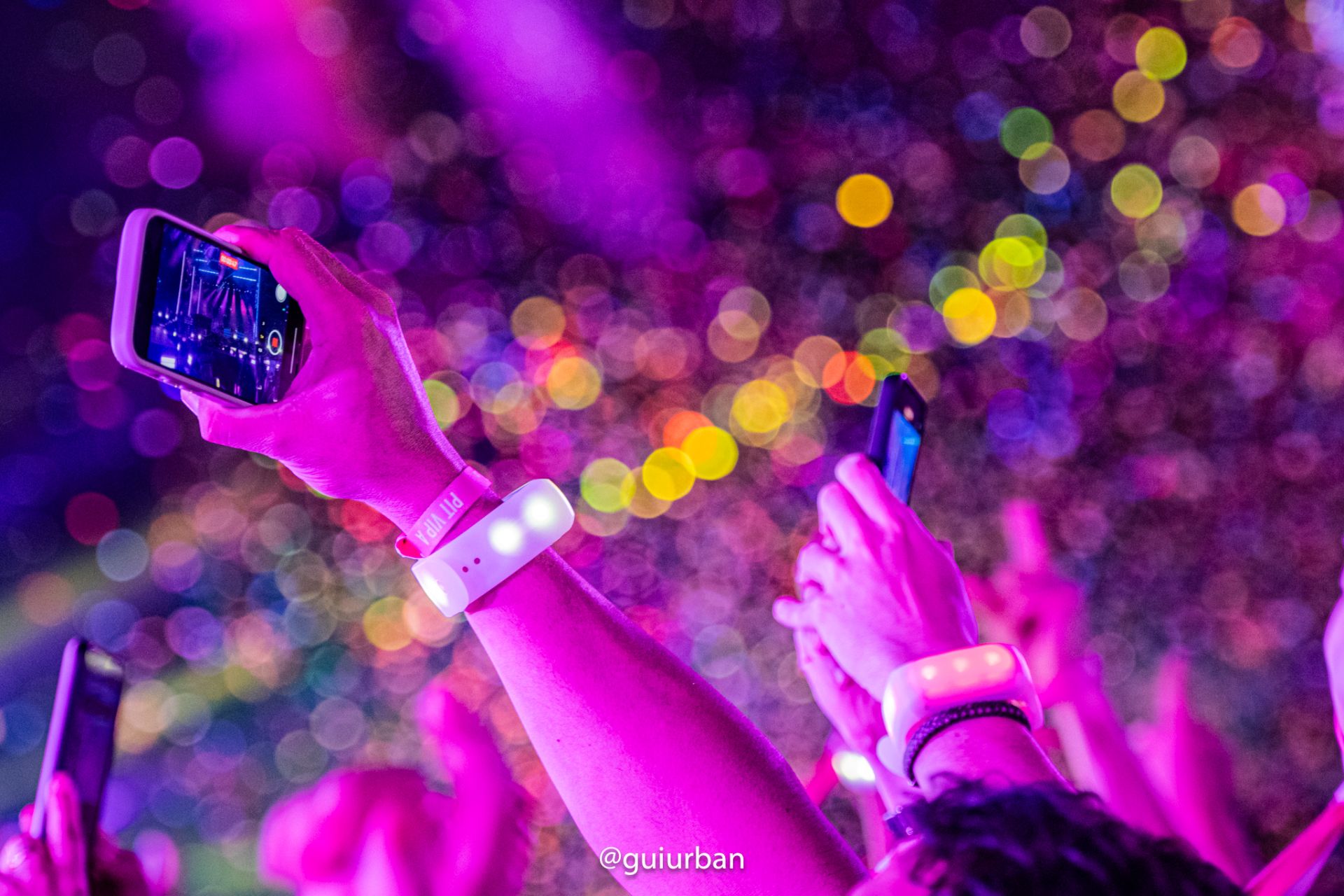
- Audience Lighting: This is where technologies like Xylobands excel. They create a vibrant, dynamic layer of light that sits between the stage and the static architecture, filling the vast middle ground. Whether it’s pulsing LED bands at a Wizkid concert or the synchronized glow of festival wristbands at PRIMER Music Festival, this layer makes the audience a living, breathing part of the scenery.
- Atmospherics: Haze and fog are essential tools for revealing beams of light, turning them from points of origin into three-dimensional sculptures in the air. This aerial texture is critical for creating the sense of an immersive event technology that envelops the entire space.
Principle 3: The Camera is the Second Audience
A modern arena tour is no longer confined to the walls of the venue. From Maluma’s global Amazon stream to the broadcast of Formula One’s 75th-anniversary celebration, the live show is now a global media event. This fundamentally changes the task of the lighting designer. Every moment must be crafted for two audiences simultaneously: the people in the room and the millions watching on screens.
This requires a deep understanding of how cameras perceive light. What looks spectacular in person can appear blown-out or muddy on a television or phone screen. Lighting for broadcast involves a delicate balance:
“You have to light for the lens. That means paying close attention to color temperature, contrast ratios, and the way light interacts with video surfaces. It’s about creating moments that feel epic both in the stands and in a close-up shot on a screen halfway across the world.”
This is where audience lighting proves its value once again. For a broadcaster, a crowd illuminated with custom LED wristbands provides a dynamic, visually rich backdrop. It transforms wide shots from dark, anonymous voids into vibrant tapestries of light and color, enhancing the broadcast’s energy and making the at-home viewer feel part of the collective experience. It’s a technique that has been perfected at global events from the Eurovision Song Contest to headline Coldplay Xylo Band moments, turning the audience itself into a stunning visual asset for the broadcast.
Principle 4: Orchestrating the Moment with Control
The most sophisticated lighting rig is useless without precise, reliable control. The bedrock of modern tour lighting is a robust combination of RF, DMX, and sometimes infrared signals that allow for the perfect synchronization of thousands of individual light sources, from a single moving head to 80,000 LED bracelets.
At Xylobands, our systems are designed for this complex, high-stakes environment. Our proprietary software and hardware allow operators to pre-program intricate sequences, but also to take manual control and react to the spontaneous energy of the show. This ability to be both scripted and improvisational is key. It’s how a designer can trigger a venue-wide color chase for a specific chorus one night, and then create a spontaneous, shimmering pulse in response to an unexpected crowd chant the next. This level of control over immersive events transforms a lighting system from a static installation into a responsive, living instrument.
The Synthesis: From Venue to Atmosphere
Ultimately, the goal of arena and stadium lighting design is to dissolve the physical limitations of the venue. It is the art of using LED event technology to build a world—a world of intimacy, of shared energy, of collective euphoria. It’s about ensuring that the person in the last seat of the upper deck feels as connected to the moment as the person in the front row.
By treating the audience as the canvas, designing for dimensional depth, keeping the broadcast lens in mind, and mastering the complex art of control, designers can achieve this transformation. They can take an anonymous concrete bowl and, for a few hours, turn it into a universe of light, a place where technology and humanity connect to create a singular, unforgettable spectacle. It is the architecture of atmosphere, and it is the future of the live experience.