The Two-Fold Spectacle: Lighting for the Room and the Camera
The Challenge of the Dual Audience
In the world of major live events, the spectacle is rarely confined to the four walls of the venue. Whether it’s a star-studded awards show, a championship sports final, or a record-breaking concert, the event is increasingly a global broadcast. This creates a fundamental challenge for production designers and lighting directors: how do you create a breathtaking experience for the audience in the room while also delivering a flawless, visually stunning product for the millions watching through a lens at home? This is the art of the two-fold spectacle.
The human eye and the camera sensor perceive the world in vastly different ways. The eye has an incredible dynamic range, capable of processing deep shadows and bright highlights simultaneously. The camera, for all its technological advancement, is far more limited. What appears as a dramatic, atmospheric silhouette in person can become a noisy, underexposed void on screen. A subtle, moody wash of colour can translate into a flat, uninteresting frame. Lighting for a live broadcast is therefore a constant, delicate negotiation between two distinct, and often conflicting, requirements.
Painting with Light for the Lens
When an event is ticketed for a live stream or television broadcast, the camera becomes the most important eye in the house. Every lighting decision must be filtered through its unforgiving lens. This is where the science of broadcast lighting comes into play, governed by principles of colour temperature, flicker rate, and exposure.
Modern LED technology, from stage fixtures to wearable-tech, must be engineered to be “camera-ready.” This means ensuring a high refresh rate to avoid the distracting banding or flicker that can plague lesser systems on camera. It’s a technical standard we’ve embedded into our own systems, from the LED wristbands used by artists like Wizkid and Maluma to our work with broadcasters like ITV on shows such as Beat The Chasers UK.
The goal is to create a visual language that translates powerfully through the broadcast, ensuring the energy and emotion of the live experience are felt by viewers hundreds or thousands of miles away.
The Crowd as a Living Set
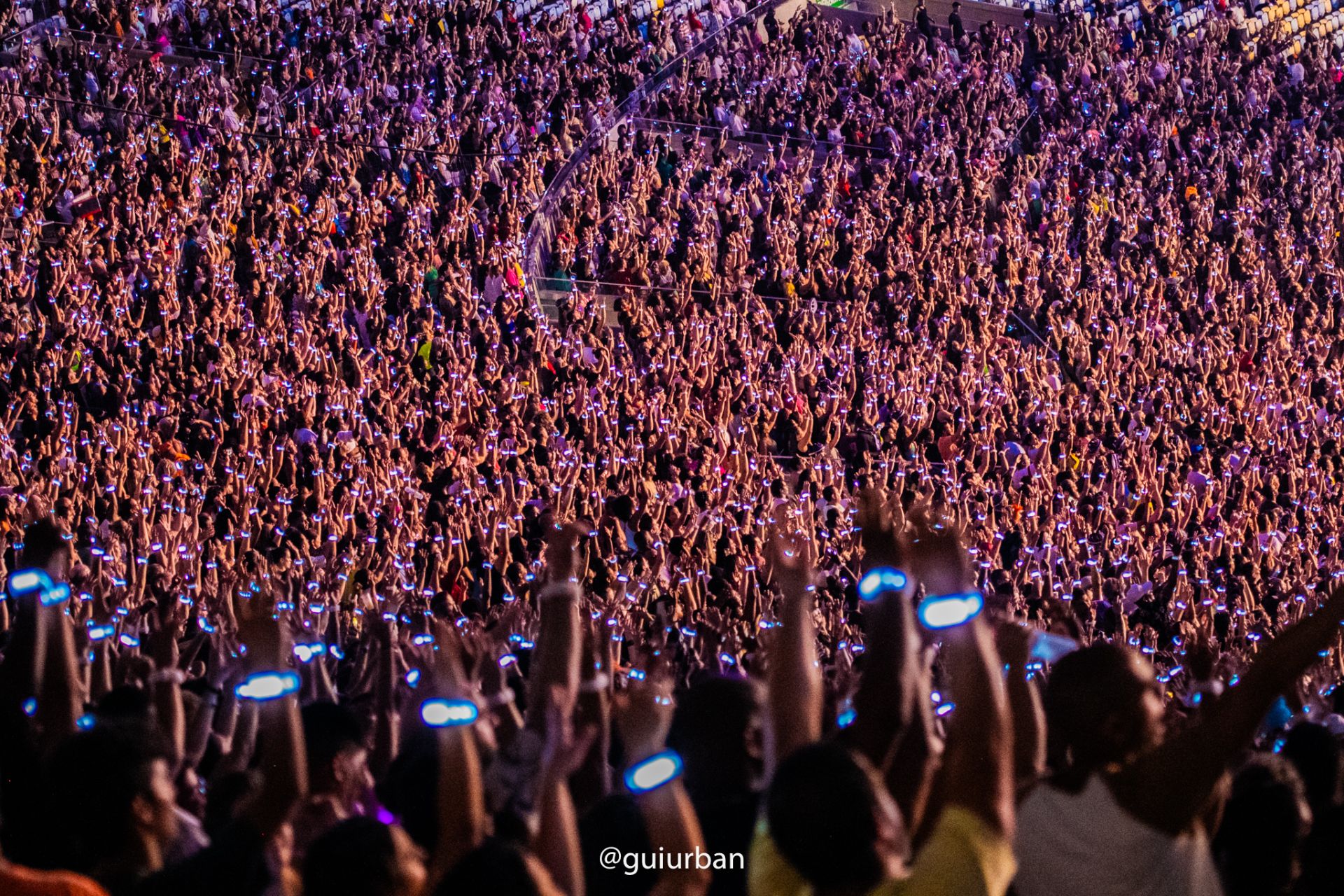
In this new broadcast paradigm, the audience is no longer a passive observer; they are a critical part of the set. They are the living, breathing backdrop for the main event. Choreographing the crowd with light is one of the most powerful tools a director has to shape the broadcast narrative. It transforms tens of thousands of individuals into a single, dynamic canvas.
This is where radio controlled LED wristbands and other LED wearables become indispensable. They offer a level of granular control that is simply impossible with traditional house lighting. A production can:
- Create Zones of Light: Segment the arena into team colours for a sporting event like the Davis Cup, or create pulsing blocks of colour that ripple through the stands.
- Frame the Action: Use the crowd’s light to draw the camera’s focus towards the stage or field, creating a natural, visually compelling vignette.
- Amplify Key Moments: Trigger a full-stadium flash for a winning goal, a dramatic reveal, or a song’s crescendo, ensuring the moment lands with maximum impact for the home viewer.
During Maluma’s historic 2022 homecoming concert in Medellín, streamed live to over 240 countries, the 54,000-strong audience became a key player in the broadcast. Their synchronized Xylobands transformed the stadium into a vibrant, pulsating entity, adding a layer of visual grandeur to the global stream.
Bridging the Gap: Unifying the Experience
While the technical demands of the camera are paramount, the experience of the in-person audience can never be an afterthought. The magic lies in creating a design that serves both masters. The most successful productions use light to unify the two audiences, making them feel part of the same shared moment.
This is the core of immersive event technology. When a fan in the stadium sees their wristband light up in perfect sync with a stunning graphic on the broadcast, the gap between the live and at-home experience shrinks. They are not just watching the show; they are in it. They are part of the light show that is being beamed around the world. This sense of participation transforms a concert into a genuine LED crowd experience.
From the high-octane energy of Formula One’s 75th-anniversary show to the electric atmosphere of PRIMER Music Festival, the goal remains the same: to create a cohesive, emotionally resonant spectacle. It’s about ensuring the spine-tingling feeling of being there is transmitted through the lens, pixel by pixel, to every viewer at home. In the modern era of live entertainment, the show is no longer just for the room—it’s for the world. And it must be lit accordingly.