The Art of the Encore: A Blueprint for the Final Moment
The Unspoken Contract
The house lights dim, the final chord still hanging in the air. A collective breath is held, followed by an eruption of applause, stomping feet, and cheers. This is the ritual of the encore, a sacred, unspoken contract between the artist and the audience. It’s a moment charged with anticipation, a shared demand for one last peak experience. But the encore is more than just a few extra songs; it's the final chapter of a story, the last word in a conversation that has unfolded over the course of an evening. For producers, artists, and event designers, it represents a unique opportunity to cement the night’s legacy, transforming a great show into a legendary one.
Beyond "One More Song": The Encore as Narrative Climax
Historically, the encore was a spontaneous response to an insatiable crowd. Today, in the era of meticulously planned large-scale productions, it has evolved into a strategic and powerful narrative tool. The most effective encores are not afterthoughts; they are the intentional climax of the entire event arc, designed with the same precision as the opening number.
Consider the energy of a festival crowd. At events like Greece’s PRIMER Music Festival, where international DJs command tens of thousands, the encore is the final, cathartic release. The goal is to channel the sustained energy of the day into a single, explosive apex. This isn’t the time for a quiet, introspective ballad. It’s a moment for the heaviest drop, the most unifying anthem, the most dazzling visual spectacle. It's about sending the audience home with their hearts still pounding, their senses fully alight.
The Psychology of the Final Moment
The design of an effective encore is rooted in a deep understanding of crowd psychology. The "peak-end rule," a cognitive bias identified by psychologist Daniel Kahneman, suggests that people judge an experience largely based on how they felt at its most intense point (the peak) and at its end. This is why the encore is so critical. It has the power to retroactively shape the entire memory of the event.
A show can be flawless for 90 minutes, but a lackluster encore can leave a lingering sense of anticlimax. Conversely, a transcendent final few minutes can elevate an entire performance, creating a disproportionately powerful and positive lasting impression. The goal is to build to a crescendo that becomes the defining memory, the story that attendees will recount for years to come.
The Palette of the Encore: Light, Sound, and Synchronicity
Crafting this peak moment requires a multi-sensory approach. While the choice of song is paramount, it is the synergy of sound, light, and technology that creates true immersion.
"The encore is your last chance to speak to the audience. You can choose to whisper, or you can choose to roar. But you must choose."
Unifying the Crowd with Light
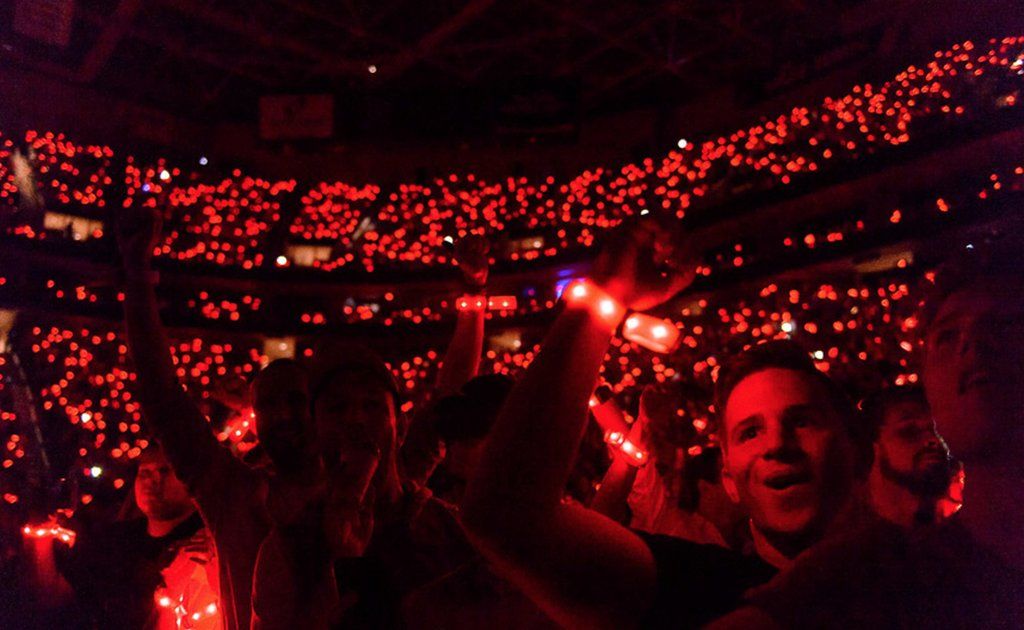
Imagine a stadium plunged into darkness, the stage bare. Then, in an instant, tens of thousands of points of light flash into existence, not on the stage, but in the crowd itself. This is the power of wearable LED technology. Radio-controlled systems like Xylobands turn every audience member into a pixel in a vast, moving canvas. It’s a profound shift in the dynamic of a show.
For an encore, this technology offers a unique palette. It allows for a final, unifying gesture that visually binds every person in the venue. When Maluma played to 54,000 fans in his hometown of Medellín, the show was a landmark moment in his career. An encore in a context like that is about legacy. Using LED wristbands to paint the stadium in the colors of the Colombian flag, or to pulse in perfect time with the final beat, doesn’t just augment the music—it creates a powerful symbol of collective pride and shared identity. It’s one of the most effective tools in creating powerful LED crowd experiences.
Designing for the Final Arc
The encore itself should have a narrative arc. A common and highly effective structure involves:
- The Return: A dramatic and visually stunning re-entrance that breaks the tension of the walk-off.
- The Anthem: A universally beloved song that the entire crowd can sing along to, fostering maximum unity.
- The Climax: A final, high-energy number that unleashes the full power of the production’s lighting, audio, and special effects.
- The Fade: A slow, deliberate fade to black, often leaving a single, powerful image—like a stadium of glowing wrists—seared into the audience’s memory.
This structure ensures the audience is taken on one final, complete emotional journey. It’s the difference between simply playing more songs and crafting a deliberate, lasting farewell.
The Lasting Echo
The roar of the crowd eventually fades, the lights come up, and the crew begins to dismantle the stage. But the encore is what remains. It is the feeling that attendees carry with them out of the venue, the memory that crystallizes in the hours and days that follow. It’s the story they tell their friends, the clip they share online, the reason they buy a ticket for the next tour.
In the modern live experience, where immersive event technology allows for unprecedented levels of spectacle and connection, the craft of the encore has never been more important. It is the final brushstroke on a masterpiece, the definitive statement that transforms a fleeting performance into a moment of true transcendence. It’s not just the end of the show; it is the beginning of its legend.