The Two-Screen Problem: Lighting for the Studio Audience and the Global Broadcast
The Dual Mandate of Modern Broadcast
In the world of live television, every major event serves two masters. There is the first audience: the sea of faces in the studio, the ticket-holders, the live crowd whose energy is the very lifeblood of the production. Their experience is visceral, immediate, and spatial. Then there is the second, vastly larger audience: the millions watching from their screens around the world. Their experience is curated, framed, and filtered through the unblinking eye of the broadcast camera.
For decades, lighting directors have navigated the delicate compromise between these two realities. A lighting scheme that feels electric and immersive in person can appear chaotic or poorly exposed on screen. Conversely, a setup meticulously crafted for the camera can leave the studio audience feeling cold and disconnected, bathed in flat, uninspired light. This is the broadcast dilemma—a technical and creative challenge that pits the physics of the human eye against the mechanics of the camera sensor.
But a new philosophy of light is emerging, one that reframes the audience not as a passive recipient of light, but as an active, dynamic component of the visual design. By embedding light directly into the crowd, we can solve the two-screen problem, creating a spectacular experience for those in the room while providing a rich, textured, and perfectly exposed canvas for the global broadcast.
The Physics of Perception: Eye vs. Sensor
The core of the challenge lies in the fundamental differences between our eyes and a camera’s sensor. The human eye has an astonishing dynamic range, capable of perceiving detail in deep shadows and bright highlights simultaneously. We can look at a spotlight without losing sight of the audience around it. A camera sensor, by contrast, has a much narrower dynamic range. It forces a choice: expose for the stage, and the unlit audience plunges into a noisy, pixelated blackness; expose for the crowd, and the performers on stage become blown-out, ethereal figures.
Furthermore, cameras are notoriously sensitive to issues like flicker rate and color temperature in ways our eyes are not. An LED source that appears stable in person might produce distracting banding or strobing on screen. This technical minefield means that traditional event lighting—often designed for raw impact and emotional effect—requires heavy adaptation for broadcast, sometimes at the cost of the in-room atmosphere.
The Audience as Canvas: A New Solution
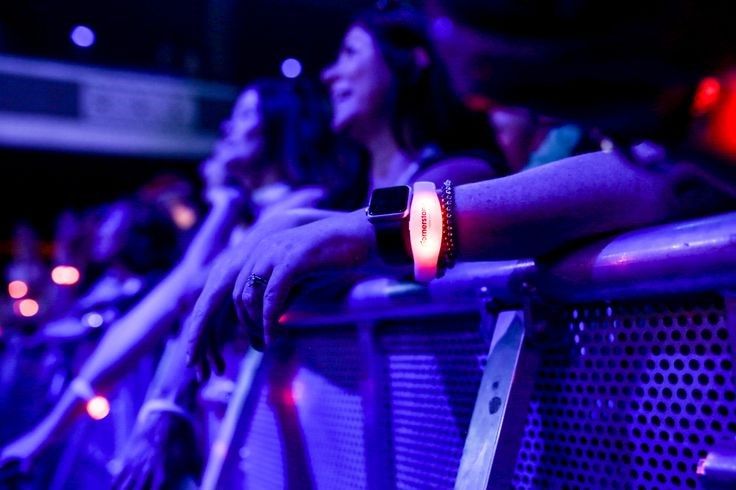
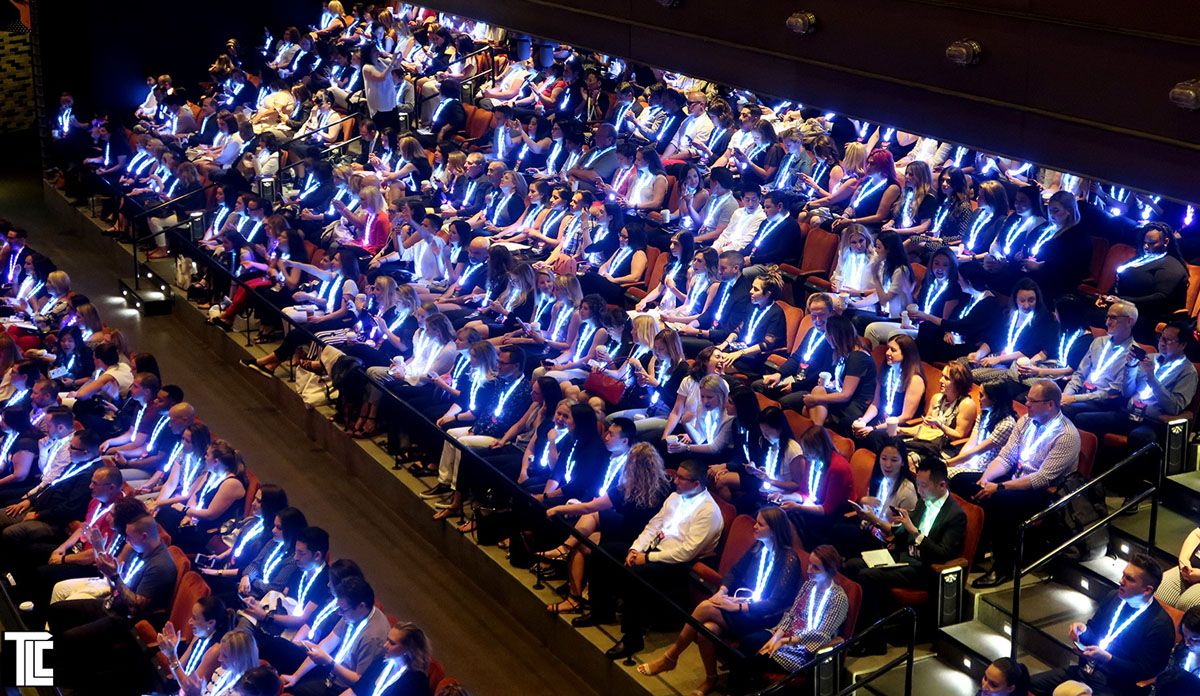
The most elegant solution is to stop fighting the darkness and instead, make the darkness a canvas. This is the principle behind modern LED Crowd Experiences. By equipping the audience with Wearable LED Technology, such as Xylobands or LED Lanyards, control is returned to the lighting designer. The crowd is no longer a passive, dark mass to be lit, but an active, programmable lighting fixture in its own right.
This approach offers several profound advantages for broadcast:
- Filling the Frame: For a camera operator, an audience illuminated from within is a gift. It transforms the negative space of the arena into a living, breathing backdrop of color and movement. Sweeping crane shots become exponentially more powerful when they glide over a synchronized sea of light.
- Controlled, Camera-Friendly Light: Unlike harsh spotlights aimed at the crowd, wearable LEDs provide a soft, diegetic light source that is inherently camera-friendly. Our systems are engineered to be flicker-free at any frame rate, and the color and intensity of every single device can be precisely controlled via DMX or proprietary RF software. This allows for the creation of stunning visual effects—sweeping color gradients, pulsing rhythms, complex patterns—that look as good on a 4K television as they do from the back row of the studio.
- Enhancing the In-Room Experience: Crucially, this technique enhances, rather than detracts from, the live experience. It creates powerful moments of unity and collective participation. For high-stakes television productions, from game shows like ITV’s Beat The Chasers to global music events, this turns the studio audience into a key part of the show’s visual identity.
From Studio to Stadium: Light on the World Stage
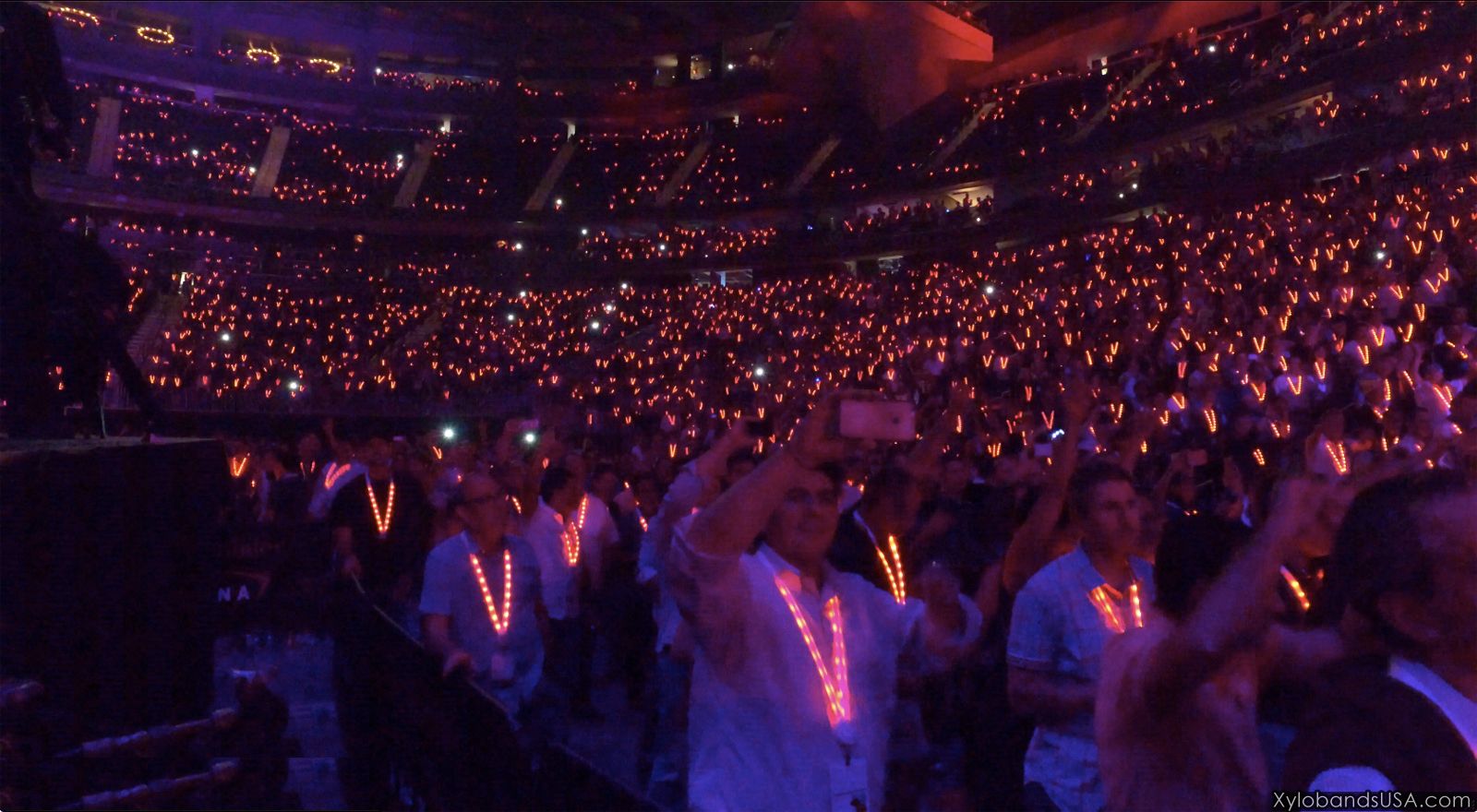
This methodology scales seamlessly from the intimate television studio to the grandest of global spectacles. At the Formula 1 75th Anniversary event, a live broadcast production, we deployed custom LED Lanyards to all 13,000 attendees. This enabled the creative team to design dynamic effects that integrated the entire arena into the show, ensuring the legions of fans at home saw a spectacle that filled every inch of their screens.
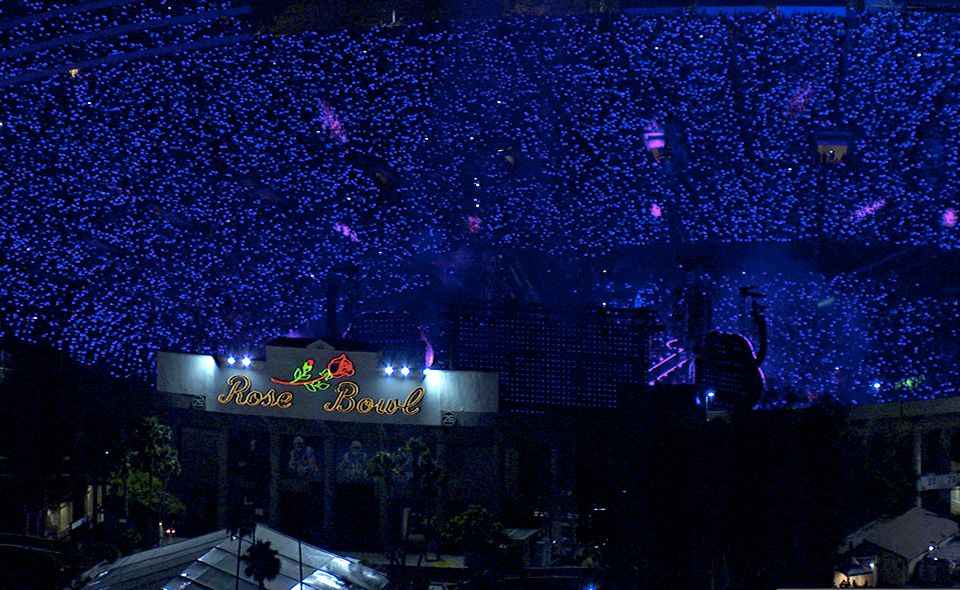
Similarly, when Maluma performed to 54,000 fans in his hometown of Medellín—a concert streamed live to over 240 countries—Xylobands were instrumental in translating the incredible live energy of the stadium to the global broadcast audience. The synchronized light show created a visual language that transcended borders, making viewers at home feel like part of the historic event.
“By turning the crowd into a pixel-mapped canvas, you give the broadcast director an entirely new visual tool. You’re not just lighting the show; you’re lighting the experience.”
A Unified Vision
The division between the live and broadcast experience is rapidly dissolving. Today’s audiences expect to feel part of the action, whether they are in the front row or on their sofa. The next generation of Immersive Events will be defined by their ability to unite these two worlds through a single, cohesive visual language.
By engineering light that serves both the human eye and the camera lens, we can create productions that are not just watched, but felt. This is more than just a technical solution; it’s a new philosophy for an era of global, shared experiences. It’s about building a bridge of light between the studio and the world, ensuring that no matter which screen an audience is watching, they are all part of the same electrifying spectacle.